Skip to content
TEAM.AS.ONE

Reports · Surveys · Assessments

Measure team psychological safety

Make team psychological safety measurable.

Two research-based diagnostics turn an abstract idea into something a team — or a leader — can see, benchmark, and act on. Explore what they measure and open a sample report.

Team Psychological Safety (TPS) for Team reports
600

Team Psychological Safety (TPS) for Team reports

Team Psychological Safety (TPS) for Leader reports
800

Team Psychological Safety (TPS) for Leader reports

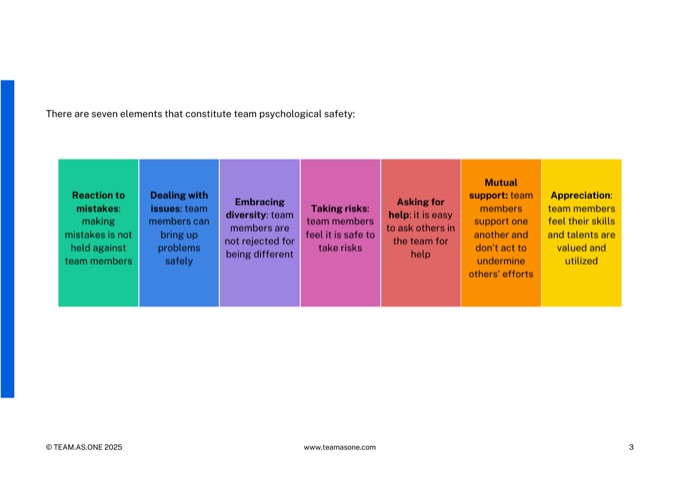
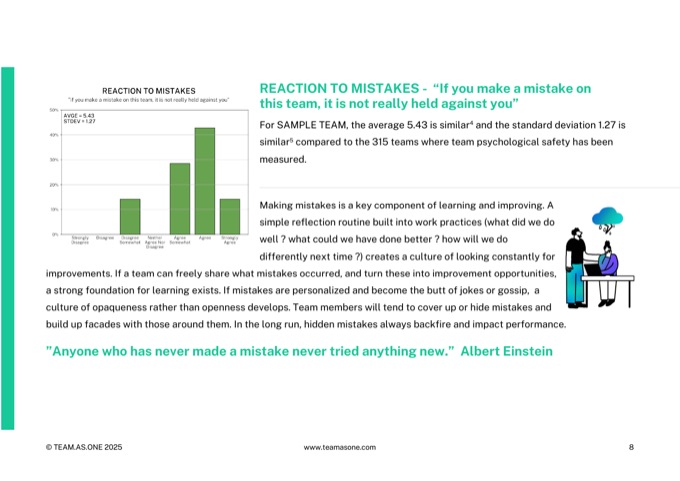
The Team Psychological Safety (TPS) for Team survey uses Amy Edmondson's seven validated team psychological safety statements, the measure used in her research since 1999. We present all seven statements in the same direction and add up to four open questions that you define. The answers become a visual report of the seven elements, benchmarked against around 600 teams in 30 countries. It takes the team 6 to 7 minutes.

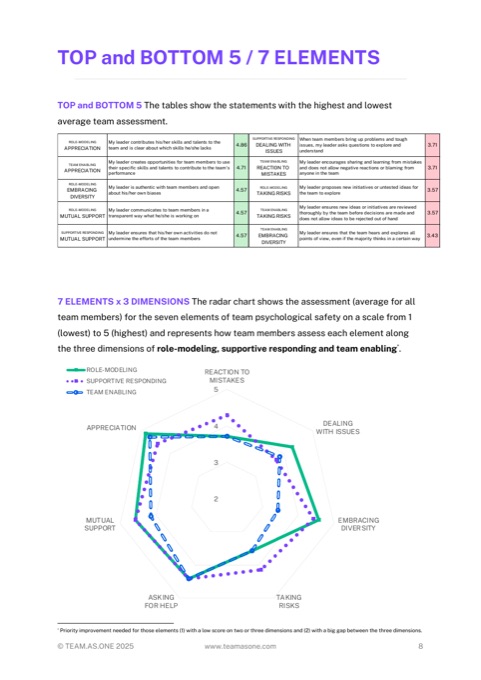
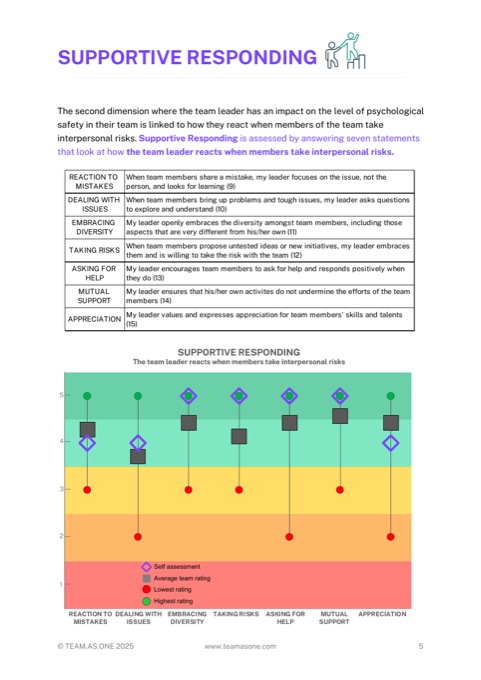
Team Psychological Safety (TPS) for Leader is an extension of Edmondson's instrument, developed by Peter Cauwelier, PhD. In 21 statements, it compares a leader's own view with the team's view on three dimensions: role-modeling, supportive responding and team enabling.

How it works

One survey looks at the team. One looks at the leader. Open a sample report for either one below.

Team Psychological Safety (TPS) for Team

Available in 14 languages
  • 7 statements (Amy Edmondson's), all in the same direction, plus up to 4 open questions that you define.
  • 6 to 7 minutes to complete.
  • Anonymous and online, in 14 languages.
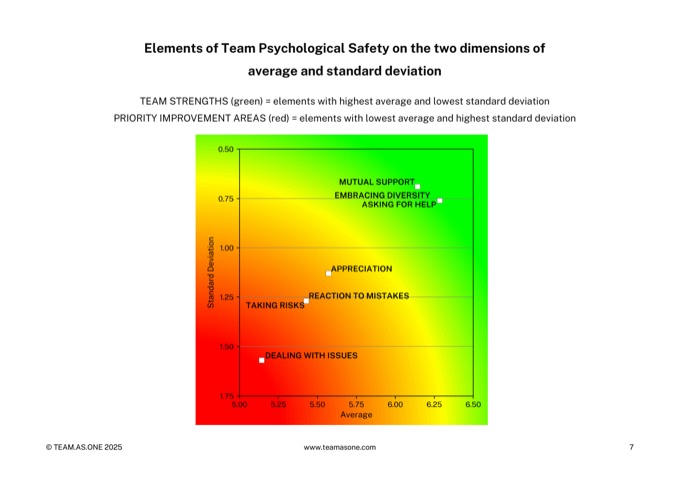
  • The report shows the seven elements, strengths, priorities, the traffic-light chart, the open-question answers, and the benchmark against around 600 teams in 30 countries.
View sample extract (PDF) →

A short extract of the full report — available in 14 languages.

Team Psychological Safety (TPS) for Leader

Available in 7 languages
  • 21 statements: 7 on each of three dimensions (role-modeling, supportive responding, team enabling).
  • Answered by the leader and by the team.
  • Anonymous for team members; online, in 7 languages.
  • The report shows the leader's view against the team's view on each dimension.
View sample report (PDF) →

The full sample report — available in 7 languages.

What people say about the reports

The report is where the conversation starts. Here's what that has looked like for the teams and leaders who've used it.

The assessment gave me valuable new insights and prompted deep reflection on the real impact I have on others. It's one thing to lead by example, but true leadership also means creating the conditions for others to grow. The result reminded me of the importance of holding space — not just for individual development, but for the team as a whole to learn how to collaborate, co-create, and thrive together. This assessment and the report helped me reconnect with that responsibility and see more clearly how I can support both individual and collective success.
Marie Tseng

Marie Tseng

Managing Director, Cultural Impact — Malaysia

The assessment gave me a much clearer understanding of how my team experiences my leadership and made me more aware of both my strengths and growth areas. The results sparked honest, insightful conversations with several of my engineers and helped us build a shared language around psychological safety. Overall, it has strengthened my self-confidence as a leader by showing where I'm already effective and where I can be more intentional in supporting the team.
Michał Samujło

Michał Samujło

Development Team Lead, Atlassian — Poland

Although I was only four months into my leadership role when we conducted the assessment, the results gave me valuable insights on my direct reports' perceptions of my leadership and the level of psychological safety they felt. I'm now focused on making behavioural shifts in two specific areas, and I'm looking forward to seeing the impact of these changes in a future post-test.
Berns Bernardo

Berns Bernardo

Assistant Vice-President, Globe Telecom — Philippines

The assessment was eye-opening for me. It highlighted areas of strength and opportunities to foster deeper trust and open dialogue within the team. By embracing these insights, I'm committed to continue creating a culture where learning from mistakes, seeking support, and valuing every contribution drive success.
Joi Natividad

Joi Natividad

Partner & Country Manager, Management Strategies — Philippines

How to get a report

Through a Team Psychological Safety Certified Practitioner, a Master Facilitator, or TEAM.AS.ONE directly.

For coaches and facilitators: Certified practitioners can run TPS for Team and TPS for Leader with their own client teams.

Questions buyers ask

How do you measure team psychological safety?+

With a short anonymous survey of the team. The Team Psychological Safety (TPS) for Team survey uses Amy Edmondson's seven validated statements, takes 6 to 7 minutes, and adds a visual report and a benchmark. The team sees where it is strong and what to work on first. Our guide compares the main options.

Is the Team Psychological Safety (TPS) for Team survey validated?+

Its seven statements are Amy Edmondson's validated team psychological safety items. They are presented in the same direction, without reverse-worded items.

How is the Team Psychological Safety (TPS) for Team survey different from the Fearless Organization Scan or PSindex?+
  • It works at the level of one real team.
  • It shows the seven elements and benchmarks the team against around 600 teams in 30 countries.
  • A practitioner uses it to design an intervention with that team. It is not an organisation-wide climate survey.
Can we compare teams?+

Yes. Each team gets its own report, benchmarked against the database, so teams can be compared on the same seven elements.

Is the Team Psychological Safety (TPS) for Team survey the same as the "TPS-7" scale?+

No. TPS-7 is a separate adaptation of Edmondson's scale by NovoPsych. TPS for Team is TEAM.AS.ONE's survey and report.

How do I get a Team Psychological Safety report?+

Through a certified practitioner, a Master Facilitator, or TEAM.AS.ONE directly.